
Corners — Rules
VOG — Vinco Online Games
Basics
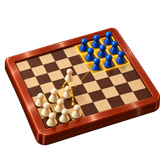
Corners (Ugolki) is a folk game played on an 8×8 checkers board. Each player has a home — a corner of the board where their pieces start. White starts in the a1 corner, black in the opposite h8 corner. In the classic game the home is a 3×3 square: a1–c3 for white, f6–h8 for black.
The goal
The winner is the first player to fill every square of the opponent's home with their own pieces. There are no captures and no kings: it is a race, not a fight. Pieces of both colours move the same way.
Moves
A move is a step or a chain of jumps by one piece. White moves first.
- Step — to a neighbouring empty square, vertically or horizontally. In the diagonal variants, diagonally as well.
- Jump — over a neighbouring piece of either colour to the empty square right behind it, in the same directions as a step. Jumps can be chained, and you may stop after any of them. A chain may not land on the same square twice.
- Steps and jumps do not mix in one move. You may not pass.
Notation
Columns are lettered a–h from left to right and rows numbered 1–8
from the bottom, as in checkers. A move is written as the path of the piece
with dashes: c3-d3 is a step, c3-e3-e5 is a chain of two jumps. At the
table moves are listed in pairs: 12. c3-e3-e5 f6-e6 is move twelve for
white and black.
Moving at the table
Click one of your pieces and the board highlights where it can go: the neighbouring squares for a step and the end of every jump chain. Hover over a square to see the path, then click it. The table takes the shortest chain: what matters is where the piece lands, not the detour it takes. With the keyboard, arrows choose a square, Enter picks a piece or moves, Esc cancels. If you play black, the board is turned so that your home is at the bottom.
Counting moves
A move is a pair: white, then black. Above the board you see the move number, the home deadline and the game limit.
Black has the last move
White moves first, so black always gets a reply. If white fills the opponent's home with its move, black makes its move of the same number. If black fills its target too, the game is a draw: both got home in the same number of moves. Otherwise white wins. If black fills its target before white, black wins at once.
Leaving home on time
All pieces must leave their home within 40 moves (30 in the diagonal variants). The deadline is checked after black's move of that number:
- whoever still has a piece at home loses;
- if both do, the game is a draw.
After the deadline you may not bring a piece back into your own home: such a move loses the game, and the table asks before making it. Jumping through your home and landing outside it is allowed.
No locking in
In the classic variants you may not make a move after which an opponent's piece is locked in — it can neither step nor jump — with one of your pieces taking part. The table will not offer such a move. Pieces locked in only by their own side (inside the home at the start, for example) do not count. In the diagonal variants locking in is allowed, but a piece locked in its own home by the opponent does not break the home deadline.
If a player has no move at all, the game is a draw, not a loss for the player who is stuck.
Game limit and repetition
A game lasts at most 80 moves. After black's 80th move the player with more pieces in the opponent's home wins; equal numbers are a draw. A position repeated three times with the same player to move is a draw too.
Time
The clock works as in chess: a time reserve for the game plus an increment per move. If your time runs out, you lose. Resign or offer a draw with the usual table buttons.
Rating
Rating is counted for every game. The rated variants are 3×3, 3×4 and 3×3 with diagonals; the other variants are unrated.
Variants
All variants follow these basics; what changes is described in separate topics: classic 3×3, classic 3×4, diagonal 3×3, diagonal 3×4, triangle home, 4×4 home, Halma 16×16, practice room.