
Filler — Rules
VOG — Vinco Online Games
Basics
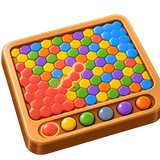
Filler is a game on a board of coloured cells. It was invented by Dmitry Pashkov: it came out for MS-DOS from Gamos in 1990, in the West it is known as "7 Colors", and in 1996 Alexander Vikulin made a Windows version with a board of hexagons. Today it is played in GamePigeon.
Goal
Each player has an area — a connected group of cells that grows from their corner of the board. Whoever has the larger area at the end of the game wins.
The move
A move is choosing a colour. Your whole area is repainted in that colour and joins every free neighbouring cell of the same colour, and then the neighbouring cells of that colour further along the chain. Cells owned by the opponent are never captured: what they hold stays theirs.
- You may not take your current colour or the opponent's current colour.
- A move that captures nothing is allowed. Sometimes it is the best move: you occupy a colour the opponent needs, and they cannot take it on their next move.
- You may not pass.
With two players the opponent cannot keep the same colour for two moves in a row, so any colour becomes available again within one move.
Your own regions
If a free part of the board borders only your area, the opponent can no longer reach it. Such a region becomes yours at once, without waiting for moves. Cutting a piece of the board off from the opponent is the main way to gain cells fast.
End of the game and the equator
The game ends as soon as the leader has more cells than the opponent could reach even in the best case: everything the opponent has plus every free region they can still reach. A decided game is not played out. With two players this means the leader has crossed the equator — they hold more than half of the board. Above the board you see how many cells you need to win, and each player shows how far they are from the equator and how far ahead of or behind the opponent they are.
The game also ends when no free cells are left. Equal counts are a draw.
A match on one board
Rated variants are played as a match of two games on the very same board: in the second game the players swap corners and the other player moves first. This cancels the luck of the colouring: each player gets the convenient corner once. Between the games each player presses "Ready for the next game".
- A game gives 1 point for a win and ½ for a draw.
- 2–0 or 1½–½ wins the match.
- At 1–1 the player with more cells over both games together wins. Equal totals make the match a draw.
Moving at the table
The colour buttons are below the board. Hover over a button and the board highlights the cells that colour would take, and the tooltip says how many. Forbidden colours are dimmed, and the tooltip explains why. On the keyboard, keys 1–9 pick a colour. If the colours are hard to tell apart, turn on colour symbols in the table "Options".
Time and conceding
The clock works as in chess: a time budget for the whole match plus an increment for each move. Whoever runs out of time loses the match. The "Concede the game" button concedes one game of the match — the next game is still played; the whole match is resigned with the usual table button.
Rating
Rating is counted only for the match, not for single games. A 2–0 or 1½–½ win is a full win; a win at 1–1 on total cells is worth less — 0.6 points against 0.4. The variants Quick 8×7, Classic 15×15, Hexagons 13×11, Four players and Pairs have their own rating scales; the other variants are unrated.
Variants
All variants follow these basics; what changes in each is covered in its own topic: quick 8×7, classic 15×15, hexagons 13×11, Vinco, diamonds, big field 21×21, obstacles and walls, valuable cells and paints, three starts, four players, pairs, practice.