Crazy Narde
The aim of the game is the same as in Backgammon: bring all your checkers into your home board and bear them off.
Starting position
The starting position and the direction of play for each colour are shown below:
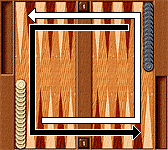
As in Narde, all 15 checkers of each player start on the head, and both players move in the same direction, counterclockwise.
First move
Each player rolls one die. The higher roll moves first, playing both numbers rolled. If the dice are equal, both roll again.
Moving the checkers
Checkers move the number of points shown on the dice. If both numbers can be played, both must be played; if only one can, the higher one is played.
A double is played four times, and then the same player, without rolling, plays every higher double in turn. For example, after 2-2 the player moves four 2s, then four 3s, four 4s, four 5s and four 6s. The chain ends with 6-6.
If a player cannot play part of the roll, the opponent plays the unused numbers without rolling. The remainder cannot be passed on again. If the first player's chain of doubles is not over, the turn returns to them afterwards.
As in Narde: only one checker leaves the head per turn (two on the first roll with 6-6, 4-4 or 3-3), there is no hitting — a single opposing checker closes a point — and a six-point prime may be built only if at least one opposing checker is ahead of it; the ban also applies within a move.
Home board and bearing off
Checkers that have entered the home board do not move until bearing off begins. Once all 15 checkers are home, they may only be borne off, and only by an exact number: a checker from the point whose number equals the number rolled. You may not move inside the home board or bear off a checker from a lower point with a higher number. Even if all checkers are on the 1-point and a 2 is rolled, the 2 cannot bear off — the opponent plays it if they can.
Draw
If both players have all 6 home points occupied by their own checkers and each still has checkers in the first quarter of their path, nobody can get past the other's home board: the game is a draw. Nobody scores, and the next game of the match is played.
Scoring
A win is worth 1 point (oin). If the loser has not borne off any checker, it is a mars (gammon): 2 points. There is no koks (backgammon). The points are multiplied by the value of the doubling cube; doubling and the Crawford rule are as in Backgammon.