Tapa
The aim of the game is the same as in Backgammon: bring all your checkers into your home board and bear them off. The main difference is that an opposing checker is not hit but pinned.
Starting position
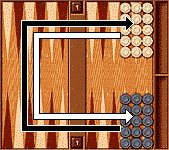
Each player has 5 checkers on each of their 24-, 23- and 22-points. The players move towards each other, as in Backgammon:
First move
Each player rolls one die. The higher roll moves first, playing both numbers rolled. If the dice are equal, both roll again.
Moving the checkers
Checkers move the number of points shown on the dice; doubles are played four times. If both numbers can be played, both must be played, in either order; if, in either order, only one can be played, the higher one is played.
Pinning
A player who lands on a single opposing checker does not hit it but pins it: the pinned checker stays on the point under the opponent's checker and cannot move until all the opponent's checkers have left that point. There is no bar in Tapa. A point is closed if two or more opposing checkers stand on it or if an opposing checker on top pins yours.
The "mother"
The "mother" is a player's last checker on their 24-point. If the opponent pins it and has no checkers of their own left on their own 24-point, the game ends at once with the opponent's win, scored as a backgammon: 3 points. If the pinning player still has checkers on their 24-point, play goes on, and they win the same way once they move the last checker off it while the other mother is still pinned. If both players' mothers are pinned, the game is a draw: nobody scores, and the next game of the match is played.
Bearing off
A player may bear off once all 15 of their checkers are in the home board; a pinned checker outside the home board prevents bearing off. Bearing off is as in Backgammon. A checker may not be borne off from a point lower than the number rolled while one of your own checkers, even a pinned one, stands on a higher point.
Scoring
A win is worth 1 point (single game). If the loser has not borne off any checker, it is a gammon: 2 points; if they also still have checkers in the winner's home board, a backgammon: 3 points. The points are multiplied by the value of the doubling cube; doubling and the Crawford rule are as in Backgammon.