
Chinese Checkers — Rules
VOG — Vinco Online Games
Basics
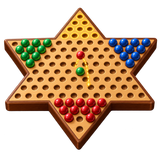
Chinese Checkers (Stern-Halma, 跳棋) is played on a star-shaped board of 121 holes: a hexagon in the middle and six triangular points of 10 holes each. Every player has their own point, where their 10 marbles start. Two, three, four or six can play. It is a relative of Corners and Halma: the same race and the same jump chains, only on a hexagonal grid.
The goal
Move all your marbles into the opposite point. There are no captures: marbles only step and jump over each other. The first to get there takes first place; the others play on for the next places.
Seating
- Two players — opposite points.
- Three players — every other point; the goals are the empty points opposite.
- Four players — two pairs of opposite points; two points stay empty.
- Six players — every point is taken.
Play goes clockwise, and the white seat moves first. Seat colours: white, red, blue, black, yellow, green.
Moves
A move is a step or a chain of jumps by one marble.
- Step — to any of the six neighbouring empty holes.
- Jump — over a neighbouring marble of any colour to the empty hole right behind it. Jumps can be chained, and you may stop after any of them. A chain may not land on the same hole twice.
- Steps and jumps do not mix in one move. Jumping is not compulsory.
Other points and the goal
- You may pass through another player's point — neither your own nor your goal — in a jump chain, but you may not end your move there.
- A marble that has entered the goal moves only inside the goal.
- A player has finished when all 10 holes of the goal are filled and at least one of the marbles there is their own. So an opponent's marble left in your goal does not stop you from finishing.
Notation
Holes are named by a letter and a number: rows 1–17 from the bottom up
and slanted lines a–q from left to right. The bottom hole of the star is
m1, the top one e17, the centre i9. A move is written as the path of
the marble with dashes: l2-l3 is a step, m1-m3-k5 a chain of two jumps.
Moving at the table
Click one of your marbles and the holes where it can go light up: the neighbouring ones for a step and the ends of all jump chains. Other players' points, where you may not stop, are greyed out. Hover over a hole to see the path, then click it. With the keyboard, arrows choose a hole, Enter picks a marble or moves, Esc cancels. Everyone sees the star with their own point at the bottom; the goal is highlighted in gold.
Leaving home on time
All marbles must leave your point within 30 moves (40 with 15 marbles). Whoever fails is out: with two players that is a loss, with three or more the worst of the free places, and their marbles are removed from the board. After the deadline you may not bring a marble back into your own point: such a move also puts you out, and the table asks before making it. A marble locked in by others does not break the deadline.
Two players: the second player's last move
The first player moves earlier, so the second has the right to reply. If the first player finishes, the second makes their move; if they finish too, the game is a draw.
Game limit and repetition
A game lasts at most 150 moves (with 3–6 players, rounds: a round is over when everyone has moved). At the limit, after a position repeats three times, or when nobody can move, places are decided by the number of marbles in the goal, and on a tie by who is closer to the goal. If just one player cannot move, their turn is skipped.
Time, resigning
The clock gives a time reserve for the game plus an increment per move. At a table of three or more, resigning or a fallen flag ends the game for everyone: the one who resigned is last, those who finished keep their places, the rest are ranked by marbles in the goal.
Rating
With two players — an Elo rating per game. With 3–6 players — a rating by places: you are compared with each opponent by place. Pairs are unrated.
Variants
Classic, 2 players, 3 players, 4 players, 6 players, long jumps, 2 players, long jumps, 6 players, 15 marbles, 2 players, pairs 2×2, three pairs.