Backgammon
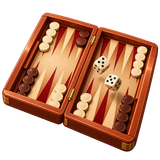
Backgammon is a game for two players. The board has 24 triangles of alternating colour called points and is divided into four quadrants of 6 points each: a home board and an outer board for each player. The home and outer boards are separated by a partition called the bar. Each player has 15 checkers of their own colour.
Starting position
The starting position and the direction of play for each colour are shown below. The players move towards each other.

A doubling cube with the numbers 2, 4, 8, 16, 32 and 64 on its faces is used to raise the stake.
Object of the game
Bring all your checkers into your home board and then bear them off. The first player to bear off all their checkers wins the game.
First move
Each player rolls one die. The higher roll moves first, playing both numbers rolled — their own and the opponent's. If the dice are equal, both roll again. After that the players take turns, rolling both dice. Every game of a match starts this way.
Moving the checkers
The two numbers on the dice are two separate moves. They may be played with one checker or with two different ones. There are three kinds of moves:
-
a checker moves forward the number of points shown on the die;
-
a checker on the bar enters the opponent's home board on the point matching the number on the die;
-
a checker is borne off if all the player's checkers are already in the home board.
A checker may not land on a point occupied by two or more opposing checkers (a closed point).
Doubles are played twice: a roll of 5-5 is played as four 5s.
If both numbers can be played, both must be played; the player chooses the order. If, in either order, only one number can be played, the higher one must be played, and the lower one only when the higher cannot. If neither number can be played, the turn is lost.
Blots
A point with a single checker on it is called a blot. If an opposing checker lands on a blot, the blot is hit and goes to the bar. While a player has checkers on the bar, they must first enter them into the opponent's home board and may not move any other checker. If a checker cannot enter (the points for both numbers are closed), the turn is lost; if only some of the checkers on the bar can enter, the rest of the roll is lost.
Bearing off
Once all 15 of a player's checkers are in the home board, they may bear them off: a checker from the point whose number equals the number rolled. If the number rolled is higher than the highest point holding the player's checkers, a checker is borne off from that highest occupied point. If there are checkers on points higher than the number rolled, that number must be played by a move inside the home board. Checkers borne off do not return to play. If a checker is hit during bearing off, the player may not bear off again until it is back in the home board.
Doubling
Before rolling, a player may offer to double if the cube is in the middle or belongs to them. The opponent either resigns the game at the current stake or accepts: the stake doubles (2, then 4, 8 and so on up to 64), the cube passes to the player who accepted, and only they may offer the next double. A player may not double if the current stake already gives them enough points to win the match, nor in the Crawford game (see below).
Scoring
If the loser has borne off at least one checker, they lose 1 point (a single game). If they have not borne off any checker, it is a gammon: 2 points. If they have not borne off any checker and still have checkers on the bar or in the winner's home board, it is a backgammon: 3 points. The points are multiplied by the value of the cube.
Optional rules
These rules are set by the room's conditions; if the room allows changing them, they can be switched on or off when you make the challenge.
-
The Jacoby rule. Gammons and backgammons count as 1 point if nobody doubled during the game. By default it is used only in Hypergammon.
-
Beavers. A player who is offered a double may immediately redouble and keep the cube; a beaver cannot be refused. Off by default.
-
Automatic doubles. If the dice are equal on the roll for the first move, the stake doubles and the cube stays in the middle; at most once per game. Off by default.
Match and the Crawford rule
Games are played as a match to the number of points chosen in the challenge. All matches use the Crawford rule: when one player first comes within 1 point of winning the match, no doubling is allowed in the next game. This is the Crawford game; in the remaining games of the match doubling is allowed again.
Source and interpretation: the Russian Ministry of Sport rules for nardy (order No. 874 of 14.09.2026), article 21 (backgammon), article 24 (doubling cube and the Crawford rule) and article 50 (scoring). Under them, a gammon and a backgammon count whether or not the stake was doubled — the same here as long as the Jacoby rule is off. The Jacoby rule, beavers and automatic doubles are optional room rules: the Ministry rules do not have them, and in backgammon they are off by default. The WBGF tournament rules expressly forbid them in tournaments as money-game rules.
规则来源
我们的规则所依据的规则书。与之不同之处已在上文说明。
- Game Rules (在新标签页中打开) — International Backgammon Federation (IBF) · 国际 · en
- Tournament Rules (在新标签页中打开) — World Backgammon Federation (WBGF), 2.1, 2023 · 国际 · en
- Правила вида спорта «нарды» (在新标签页中打开) — Минспорт России, № 874, 2026 · 俄罗斯 · ru