Games of the World: Ludo, from Indian Pachisi to a billion phones
 khorost
✔
·
·
5 min lezen·👁 6
Cowrie shells and Akbar's living pieces, an English patent of 1896, Germany's “Don't Get Angry” and Ludo King. Why Ludo is not in our near-term plans yet — and which races to play instead.
The third article in our "Games of the World" series is about one of the best-known board games in the world. It has a dozen names: Ludo, Pachisi, Parchís, "Don't Get Angry", "Little Horses". If as a child you raced counters around a cross on a cardboard board, this is the game.
The Indian root: Pachisi
Ludo's ancestor is the Indian game of Pachisi. The name means "twenty-five" — the score of the best throw. The board was embroidered on cloth in the shape of a cross, with three rows of squares on each arm and a "home" in the middle. Instead of a die, players threw six cowrie shells and counted how many landed mouth up. None meant 25 points, one meant 10, the rest counted their number.
Four people played, two pairs, with four pieces each; on twelve "castle" squares a piece could not be captured.
There is a lovely story: in the 16th century the Emperor Akbar played at Fatehpur Sikri on a huge board laid out in a courtyard, with living people as the pieces. It is a tale rather than a record, but the large courtyard boards themselves are the earliest secure evidence of the game in India.
England, 1896: the birth of Ludo
In 1896 the Englishman Alfred Collier brought out a simplified Pachisi called Ludo (Latin for "I play") and later patented it as Royal Ludo. The shells gave way to an ordinary die, and the pairs to every player for themselves.
Almost everyone knows the rules — here is the most common version, though every family and country has its own details:
- each player has four pieces of their colour, and they enter the board only on a six;
- a six gives another throw, but a third six in a row is lost;
- land on an opponent's piece and it goes back home;
- two of your pieces on one square form a block that cannot be passed;
- you need an exact throw to get "home". The first to bring all four pieces home wins.
One game, ten names
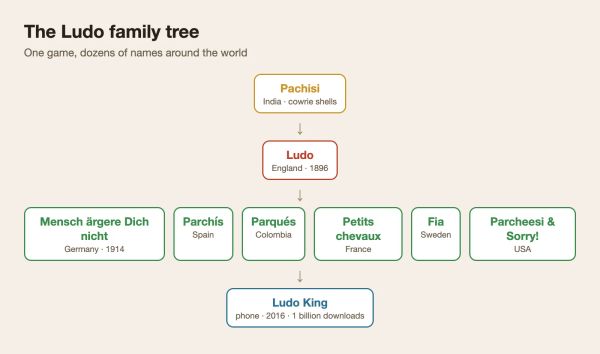
Ludo spread around the world and became a "national" game in every country:
- Germany — "Mensch ärgere Dich nicht" ("Man, don't get angry"). Josef Friedrich Schmidt came up with it in the winter of 1907/08 and it went on sale in 1914; about 70 million copies have been sold. Schmidt simplified the rules into a quick family race.
- Spain — Parchís, Colombia — Parqués, France — "little horses" (petits chevaux), Sweden — Fia, British sailors — Uckers.
- USA — Parcheesi and "Sorry!", commercial versions from major publishers.
A second life in the phone
In 2016 the Indian studio Gametion released the Ludo King app, and Ludo came home again — this time on a smartphone. During the 2020 lockdown more than 50 million people played it every day, and in 2024 it passed a billion downloads. It is one of the most popular board games in the world.
And at VOG?
Status at VOG: under consideration, but Ludo is not in our near-term plans. The club does not run games for money. We choose games by the player's decisions, community interest, a suitable competitive format and the resources to build them well. For Ludo two things matter:
- Priorities. Luck plays a bigger part in Ludo than in the games we are focusing on now — games where the rating and the analysis of a game depend more on the player's decisions.
- The game already has a home on the phone. Ludo King has a billion downloads, and just one more Ludo would add little for players.
We will come back to Ludo if we see that club players miss it — for instance, as a game for the whole family with children.
What to play instead
If you love racing your pieces home, we have races with more decisions:
- backgammon — dice too, and "hit and send home" too, but with a depth that takes years to master;
- Chinese checkers — a race across a star for up to six players, with no die at all;
- Ugolki — a race for two or four on a checkers board.
And Ludo itself is best played the way it always has been: at the table, with the family, a cardboard board and a cry of "Don't get angry!".