Games of the World: Chinese checkers — neither Chinese nor checkers
 khorost
✔
·
·
4 min lezen·👁 10
From the English Hoppity and the American Halma to the German star of 1892 and a marketing name from 1928. How to play, why six players make it a different game — and where to play it right now.
The fifth article in our "Games of the World" series is about the game with the most misleading name in the world. Chinese checkers is neither Chinese nor checkers. It is a German game with an American name — and you can play it with us right now.
Not from China
It all began with jumping across a squared board. In 1854 a game called Hoppity was devised in England, and in 1883–1884 the American Harvard surgeon George Monks based Halma on it — from the Greek for "leap". A 16×16 board, camps of pieces in the corners, and the task of moving your whole troop into the opponent's corner by jumping over other pieces, theirs and your own.
In 1892 in Germany the same game was put on a star of 121 holes — and Stern-Halma, "star Halma", was born. The star's six points made it possible to play not only with two or four players but also with three and six.
The "Chinese" came from marketing. In 1928 the American brothers Bill and Jack Pressman began selling star Halma, first as "Hop Ching Checkers" and then as Chinese Checkers — an Eastern name sounded exotic. The name caught on all over the world, and the game itself also reached China, where it is called 跳棋 ("jumping checkers"), and Japan, which has its own variant, the "diamond game".
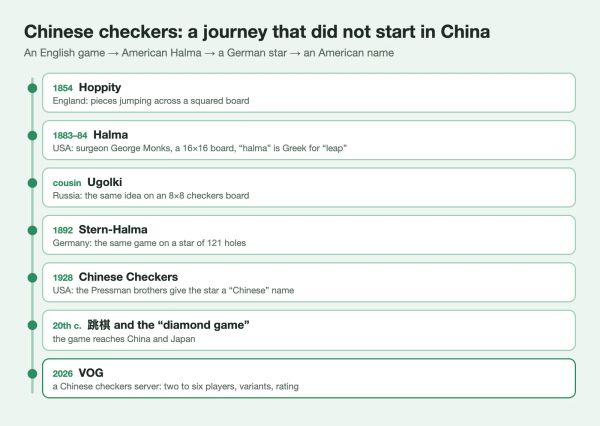
We also have a close relative of Halma — Ugolki ("Corners"): the same race with jumps, but on an ordinary checkers board.
How to play
- Each player starts in their own point of the star with 10 pieces. The goal is to be first to move all of them into the opposite point.
- A move is a step into a neighbouring hole or a chain of jumps over neighbouring pieces, yours and others'. You can jump as many times in a row as you like, changing direction.
- There are no captures — pieces are only jumped over.
- You may pass through other players' points but not stop in them.
All the depth of the game is in the chains. A good "ladder" of pieces lets you fly across half the board in one move, and the main question in every game is how to build a ladder for yourself without building one for your neighbour.
With six it is a different game
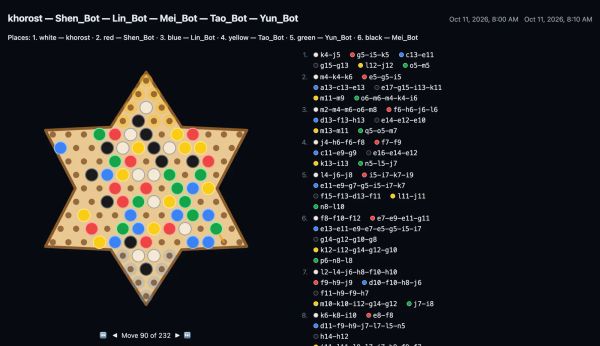
Chinese checkers is one of the few board games that seats six. With six players the centre of the board is packed, ladders appear by themselves, and every move changes the picture for everyone. The first to finish wins, and the rest play on for places.
And at VOG?
Status at VOG: available — play right now:
- with two, three, four or six players;
- variants: classic, long jumps, 15 marbles, pairs, "Masters" with swapping, and symmetric jumps;
- a two-player rating and a rating by places at bigger tables;
- rooms with bots — five bots from beginner to strong player, so you can fill a six-player table at any moment;
- a game against a bot right in your browser, no sign-up needed — the "Play right now" card on the game page.
And if you want the same jumping race but for two and on a familiar board, try Ugolki.