
Games of the World: tavli, three backgammon games in one
In Greece backgammon is played as a set: portes, plakoto with its pinning and the “mother” checker, and fevga. All three have close relatives in our club, and we are considering tavli itself.
The ninth article in our "Games of the World" series is about backgammon — but not ours. In Greece backgammon is called tavli (τάβλι), and it is not one game but three, played in turn on the same board. The most interesting part: all three have close relatives in our club.
A board in every kafenio
The word "tavli" comes from the Latin tabula, "board": that was the Roman name for the game considered the ancestor of backgammon. In Greece and Cyprus tavli is the national game. You will find a board in every kafenio, the village coffee house: old men play from morning till night, with the loud clack of checkers and comments from onlookers. Greeks took tavli with them when they emigrated — in Australia, for example, Greek communities hold their own tavli evenings and tournaments.
Three games in turn
A tavli match goes to 5 or 7 points, and the games follow each other in rotation: portes, plakoto, fevga, then portes again. One pair of dice is shared by both players. Winning a game scores 1 point, and 2 if the opponent has not borne off a single checker.
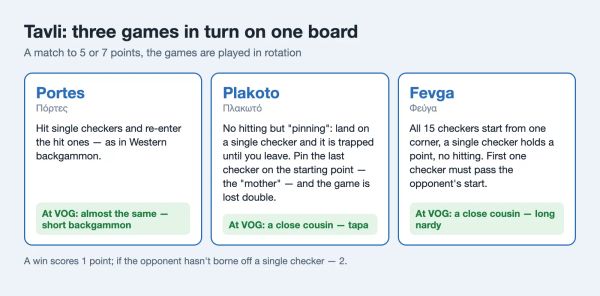
Portes — "gates"
The most familiar of the three: the checkers move towards each other, and a single opposing checker can be hit, after which it has to re-enter the game. In essence this is our short backgammon and Western backgammon, with Greek details in the scoring.
Plakoto — "pinning"
Here the checkers also move towards each other, but instead of hitting they pin. Land your checker on a single opposing checker and it is trapped under yours and cannot move until you leave. A pinned checker is not out of the game, but the trapped player loses tempo, and sometimes the whole game.
The main rule of plakoto is the "mother" (mana): the last checker on the starting point. If the opponent pins it before it has left, the game is lost double. A similar game is played in Bulgaria and North Macedonia under the name tapa.
Fevga — "run"
Each player's 15 checkers all start in their own corner, the corners are opposite each other, and both sides move in the same direction. There is no hitting, and a single checker already holds a point. First one checker must pass the opponent's start, and only then may the others move. You may not build a wall of six points in the first quarter — yours or the opponent's — and you may not block the opponent completely; though not every region of Greece enforces this.
If you have played long nardy (long backgammon), all this will feel familiar: fevga is its close cousin, with the same idea that "a single checker holds a point" and local subtleties of its own. Greeks consider fevga the cleverest of the three: luck matters least in it.
And at VOG?
Status at VOG: under consideration. Greek and Balkan backgammon is among the first entries in our catalogue of new games. Plakoto is very close to tapa and fevga to long backgammon, and we already have both; but tavli has its own local details, scoring rules and the "three games in rotation" format itself.
Meanwhile, play tavli's closest relatives: short and long backgammon and tapa. If you play tavli or tapa, write to us about the rules you use — after all, every region of Greece plays tavli a little differently.