Games of the World: mus, Spain's game of cards and gestures
 khorost
✔
·
·
5 min de lecture·👁 4
We start a series about games from different countries. Mus: a Basque card game for two pairs, four contests in one deal, the all-in “órdago” and allowed signals to your partner — and why it is in our plans.
We are starting a series called "Games of the World": stories about board and card games from different countries — where they come from, how they are played, and whether you can play them in our club. The first one is mus, Spain's favourite card game.
Where mus comes from
Mus comes from the Basque Country. The earliest known mention dates from 1745, when the Jesuit Manuel Larramendi included it in his Basque–Spanish–Latin dictionary. The first written rules appeared in Pamplona in 1804 and were later reprinted in Madrid. Around 1850 the Englishman Richard Ford called mus a game "of cards and gestures" — and that is the best description of it.
Nobody knows where the name comes from. Suggestions include the Basque musu ("kiss") and the Latin musso ("to keep silent").
Basque emigrants took mus to Latin America, the USA and Australia, where it lives on in Basque clubs.
Deck and goal
It is played by four people, two against two, with a 40-card Spanish deck — no eights, nines or tens. Partners sit opposite each other.
In most of Spain threes count as kings and twos as aces ("eight kings"). In the Basque Country, Navarre and La Rioja threes and twos are ordinary cards ("four kings").
A game goes to 40 points (30 in some places); traditionally points are counted with beans or pebbles. Several games make a "cow" (vaca), and several cows make a match.
Mus: the discard
Each player gets four cards. Then, in turn, everyone says "mus" — I want to discard — or "no mus". If all four agree, each discards as many cards as they like and draws new ones. This repeats until someone refuses. A refusal usually means that player has a good hand.
Four contests
One deal is four separate contests (lances), and in each of them the pairs compete again with the same hands.
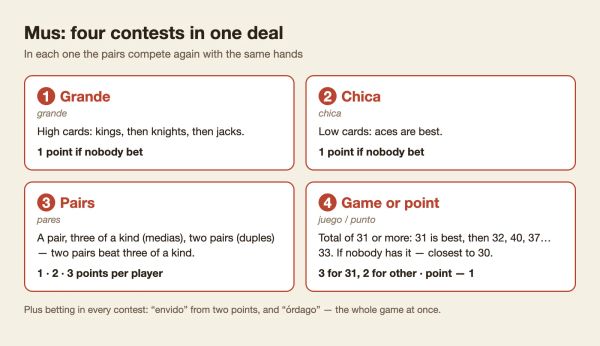
- Grande — highest cards win: kings, then knights, then jacks.
- Chica — the opposite, lowest cards win: aces are best.
- Pairs (pares) — a pair, three of a kind (medias) or two pairs (duples). Two pairs beat three of a kind — unlike poker. A pair scores 1 point, three of a kind 2, two pairs 3.
- Game (juego) — a hand total (face cards count 10) of 31 or more. Exactly 31 is best, then 32, 40, 37, 36, 35, 34, 33. A 31 scores 3 points, any other "game" 2. If nobody has a "game", they play point (punto) instead: closest to 30 wins, 1 point.
Betting
In each contest players can pass or bet (envido, two points or more) in turn. The opponent accepts, raises or refuses. Accepted bets are settled at the end of the deal; a refusal gives the bettor a point at once.
The loudest word in mus is órdago: a bet on the whole game at once. If it is accepted, the cards go on the table and the game is decided by that single deal.
Signals to your partner
What people love mus for — and what makes it unique — are the allowed signals (señas). Partners may show each other their hands with facial expressions, and the signals are the same for everyone:
- biting the lower lip — two kings;
- sticking out the tip of the tongue — two aces;
- a wink — 31;
- raising the eyebrows — two pairs;
- closing the eyes — a poor hand.
You may not invent signals — only the common ones count. And the opponents are watching too: catching someone else's signal is part of the game, and giving one unnoticed is an art.
Where it is played today
Mus is the most popular card game in Spain: it is played in bars, peña clubs and student halls all over the country, as well as in France, Latin America and the Basque clubs of the USA and Australia. There is no single official federation, and the rules differ noticeably from region to region, so players agree before they start: how many kings, how many points, whether you may bluff when declaring pairs.
The main tournament is the World Championship of Basque communities: the 46th was held in Argentina in 2025, the one before in Peru in 2024. The Spanish Mus Association holds an International Masters every November.
And at VOG?
There is no mus in the club yet — it is in our plans and listed in our games catalogue. The most interesting question for an online version is the signals: at a real table both your partner and your opponents can see them, and online they need to work so that the hint to your partner remains — and so does the chance to intercept it.
If you play mus, write to us about the rules you use: it will help us make the game the way you know it.
Meanwhile, in the club you can play in pairs in dominoes (the four-player "Goat") and in Chinese checkers pairs, and play tricks in Hearts.