Basics
Mus is the great card game of the Basque Country and of all Spain: four players in two partnerships sitting opposite, a Spanish deck and betting on four "lances" — contests for the highest cards, the lowest cards, pairs and points. The cards are hardly played at all: bets, bluff and signs to your partner decide everything. A game goes to 40 stones, the match to two games won.
The deck
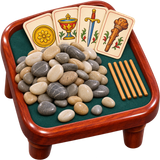
The deck has 40 Spanish-suited cards: oros (coins), copas (cups), espadas (swords) and bastos (batons); each suit has the cards 1–7 and the court cards sota (10), caballo (11) and rey (12).
Our tables play "8 kings" by default: threes count as kings and twos as aces, so the deck has eight kings and eight aces. The 4 reyes table plays without this.
Rank (high to low): king, caballo, sota, 7, 6, 5, 4, ace. Points of a card for juego and punto: court cards and kings 10, aces 1, the rest their number.
Seats and the deal
Partners sit opposite: seats 1 and 3 against 2 and 4. A draw picks the dealer of the first deal; after that the deal passes round the table. Each player gets four cards, dealt one at a time. The first to speak and bet is the mano — the player after the dealer; when hands are equal, the one closer to the mano round the table wins.
The exchange: "mus" or "no hay mus"
Starting with the mano, each player says "Mus" (I want to change) or "No hay mus" (no change). If all four say mus, everyone discards one to four cards and draws as many from the deck — all at once, and everybody sees how many each player took. Then there is another round of mus. The first "no hay mus" ends the exchange and the betting begins.
When the deck runs out, the discards are shuffled into a new deck — except the cards the drawing player discarded in this exchange.
The four lances
The players bet on four lances in turn:
| Lance | Who wins |
|---|---|
| Grande | the highest cards: compared by the top card, then the next |
| Chica | the lowest cards: by the lowest card, then the next |
| Pares | the best combination: duples (two pairs, four of a kind) beat medias (three of a kind), medias beat a pair |
| Juego | 31 points or more: la real, 31, 32, 40, 37, 36, 35, 34, 33 |
La real is three sevens and a sota: 31, better than any other 31. If nobody has juego, punto is played instead: the total closest to 30 wins.
Before pares and juego each player declares whether he has them — the table does this for you. Only players who have the lance bet in it; if only one partnership has it, there is no betting, and it scores its hand points at the count.
Betting
The mano speaks first in a lance (or the first player after him who has it):
- Pass — no bet. If everyone passes, the lance is "en paso" and is decided at the count.
- Envido — a bet of 2 stones or more.
- To a bet the opponents answer Quiero (accept), No quiero (refuse) or raise.
- Órdago — a bet of the whole game. An accepted órdago shows the hands at once: whoever wins that lance wins the game.
Both opponents answer in turn: if the first refuses, his partner decides. If both refuse, the betting side takes the stones of the bet already accepted (or one stone if it was the first bet) — at once, not at the count.
If a bet in pares, juego or punto is won by a refusal, at the count that pair also scores the points of its hands (pares, juego) or the stone for punto.
The count
After juego (or punto) the hands are shown and the lances are counted in order:
- Grande and chica: the accepted bet; en paso, 1 stone.
- Pares: the bet plus the hand points of the winning side — a pair 1, medias 2, duples 3 (for each partner who has them).
- Juego: the bet plus hand points — 31 scores 3, any other juego 2.
- Punto: the bet plus 1.
The first side to reach 40 wins the game — nothing after it is counted. Once a game is won, the score is reset and the next game begins; the match is won with two games.
Signs to your partner
After "no hay mus" and before the showdown you may show your partner a sign — what is in your hand: two, three or four kings, two, three or four aces, medias, duples, 31 or ciego (no pares and no juego). Only your partner sees the sign, and the table will not let you show a false one. More in the rules of the Mus table.
Clocks and rating
Clocks are compulsory: 10 or 15 minutes per player plus 5 seconds a move. If a player runs out of time or resigns, his partnership loses the game. The Mus rating is personal, by your partnership's result; on rated tables the partnerships are drawn by lot. The table chat is closed during a game — you can help your partner only with signs. The deal is fair: the deck of every deal can be checked after the game.