
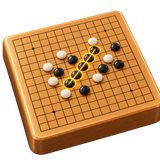
Fours and threes
All gomoku tactics rest on two threats.
A four threatens to make five on the next move. It must be answered at once — by placing a stone on the single point that completes the line. An open four (both ends free) is already a win: you cannot block two ends with one move.
An open three is three stones in a row or with one gap (h8 i8 k8), with
both ends free. On the next move it becomes an open four, so an open three
must be answered too: block one of its ends or put a stone into the gap.
How to answer a three
Block a three on the side where your stone also builds something of your own: that way you don't just defend, you prepare a threat of your own. If you have a four of your own, you can play it first — the opponent must answer, and you gain a tempo.
Closed lines
A closed three or a closed four is less dangerous: a closed four has one point for five, and it is easy to take. But closed lines are material for an attack: every closed four is a move the opponent is forced to answer. A chain of such moves lets you reshape the position in your favor (see attacking with fours).