
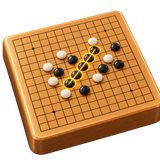
Renju
Renju is the tournament form of gomoku, played under the rules of the Renju International Federation (RIF). The board is 15×15, stones go on the intersections, and the goal is the same — five of your stones in a row. But Black, who moves first, has forbidden moves, while White wins more freely. Renju games count toward their own rating, "Renju".
Who wins with what
- Black wins only with exactly five stones in a row.
- White wins with five or more: six white stones in a row win too.
Black's forbidden moves
Black may not place a stone where it creates:
- a 3×3 fork — two open threes at once. A three is a line that can become an open four (four in a row with both ends free) in one move, and that move must itself be allowed;
- a 4×4 fork — two fours at once, including two on the same line;
- an overline — six or more black stones in a row.
A move that makes exactly five always wins, even if it is a fork at the same time.
At the table forbidden points are marked with a red cross: Black cannot play there, and White can see where Black is not allowed to go. This is White's main weapon — forcing Black to block a threat with precisely a forbidden move. White has no forbidden moves.
Pass
You can skip a move with the "Pass" button. Two passes in a row make a draw. The game is also a draw if the board fills up and nobody has five.
The Taraguchi-10 opening
Forbidden moves only partly offset the first-move advantage, so the start of the game is balanced as well. The first player starts with Black.
- The first stone (black) goes in the center of the board.
- The second (white) goes in the 3×3 square around the center, the third (black) in the 5×5 square, the fourth (white) in the 7×7 square.
- After each of the first three stones, the player who currently plays the color of the next stone decides: swap colors with the opponent or keep their color.
- After the fourth stone, Black decides — one of two ways:
- swap colors or keep them, and then the fifth stone (black) goes in the 9×9 square; after that White decides once more whether to swap colors;
- or, right away and without a swap, offer exactly 10 options for the fifth move anywhere on the board, and White picks one of them. Options symmetric to each other are not accepted: they would lead to the same position.
- Then White moves, and the game goes on as usual.
The idea of the swaps is simple: no player will keep a position that is bad for them — they will swap colors. So it pays to set up an even opening.
Playing at the table
The square where the opening stone goes is outlined with a dashed line. Opening decisions are made with the buttons above the board. To offer options for the fifth move, press "Offer options", mark the points by clicking (a number appears on the point; clicking again removes the mark) and press "Offer". White sees the options as rings and picks one with a click.
Source and interpretation: the RIF Renju rules and the Taraguchi-10 opening rule. Under the code a forbidden move by Black loses if White points it out; here such a move is simply not accepted — a red cross shows where Black may not play.
Rule sources
The rulebooks our rules are based on. Where we depart from them is explained in the text above.
- International Rules of Renju (opens in a new tab) — Renju International Federation (RIF), 1996; 1998 · international · en
- Taraguchi-10 Rule (opens in a new tab) — Renju International Federation (RIF) · international · en