
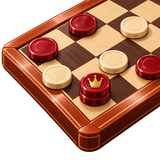
Parlett's draughts
-
8×8 two-tone board, all 64 squares are used. Each player has 12 men: Black stands on the dark squares of its three nearest rows, White on the light squares of its own three rows, four men per row. Square a1 is dark. Black moves first.
-
Every piece stays on squares of its own colour for the whole game: a diagonal step and a straight jump over one square never change the colour. So the opponent's pieces never block an ordinary move — only your own pieces do.
-
A man moves one square diagonally forward.
-
A man captures in a straight line, forwards or sideways: it jumps over an adjacent enemy piece onto the empty square right behind it. A man never captures backwards.
-
A king moves one square diagonally in any direction. It captures in a straight line in all four directions, also over an adjacent piece onto the square right behind it.
-
Capturing is compulsory. If several captures are possible, you may choose any of them, even a shorter one, but once a sequence is started it must be completed with the same piece. Captured pieces are removed after the move, and no piece can be jumped twice.
-
A man that reaches the last row becomes a king, and the move ends there, even if further captures would be possible.
-
If a capture is missed, no piece is huffed: the server simply does not accept such a move.
-
A player who cannot move loses. Draw: the same position occurs four times; 50 moves by each player in a row without a capture or a promotion.
Source: D. Parlett, "The Oxford History of Board Games" (1999), the Black and White variant. Whatever its description leaves out is taken from the Anglo-American checkers rules in the same book.