
Games of the World: games of the Indigenous peoples of the Americas
 khorost
✔
·
·
6 Min. Lesezeit·👁 5
Aztec patolli, Maya bul, the Haudenosaunee bowl game and slahal: how they are played, why we will not make online versions — and how to play bul at home with four corn kernels.
The second article in our "Games of the World" series is about the games of the Indigenous peoples of the Americas: Aztec patolli, Maya bul, the Haudenosaunee bowl game and the stick game of the north-west. We will tell you how they are played and what they mean to their peoples — and you can play bul at home today.
A hundred and thirty peoples and dice made of anything
In 1907 the American museum curator Stewart Culin published Games of the North American Indians, the classic reference on the subject. He divided the games into two large families: games of chance (dice and guessing) and games of skill. He found dice games among 130 tribes from 30 language families. Dice were made from whatever was at hand: wood, cane, bone, animal teeth, fruit stones.
Patolli: the Aztec game of 52 squares
Patolli was played all over Mesoamerica — by the Toltecs, the Aztecs and the Maya. Commoners and nobles alike loved it: Moctezuma II is said to have enjoyed watching his courtiers play.
- The board is a cross or an "X" of 52 squares, and the pieces travel round it.
- Each player has six pieces.
- The dice are black beans with a hole on one side: you count how many holes land face up.
- The goal is to be first to bring all six pieces to the end of the track.
Patolli was a betting game: people staked blankets, stones, gold, food and, in extreme cases, their home or even their freedom. Its patron was the god Macuilxochitl, and the game had a special "offering corner". The Spanish friars Durán and Sahagún described patolli in the 16th century, and the colonial authorities banned and persecuted it.
Bul: a battle on a road of corn
Bul (also called puluc) is still played by the Maya in Belize and the highlands of Guatemala. It is not a race but a battle: the pieces move towards each other and take prisoners.
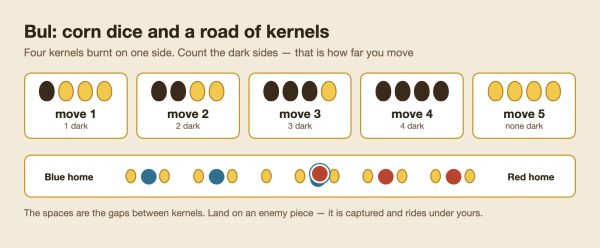
- Dice — four corn kernels burnt on one side. Count the dark sides that land up and move that many spaces (1–4); if none are dark, move 5.
- The road — a row of kernels or sticks; the spaces are the gaps between them. Usually 10–20 spaces, with each side's home at one end.
- Pieces — five per side: pebbles, twigs, leaves.
- Prisoners. Land on a space with an opponent's piece and it is captured and rides under yours. Capture a piece that already carries prisoners and you take the whole stack. When a piece reaches the end of the road, it and its own side's pieces in the stack go back home, and the enemy pieces are removed.
It is played by two players or by teams. Whoever knocks out all the opponent's pieces wins. Bul has no single rulebook: the length of the road, how pieces enter and how stacks move differ from village to village.
The bowl game: the sacred game of Midwinter
The Haudenosaunee (Iroquois) peoples have a game with six peach stones blackened on one side. They are shaken in a wooden bowl and you count how many dark and light sides land up; the score is kept with 101 beans, one of which is for the Creator, who decides the outcome.
This is not entertainment but part of the Midwinter ceremony: according to tradition the game was a gift to the people from the Creator, and in some accounts its outcome foretells the coming year's harvest. Clans play against clans, or men against women.
The stick game: songs against the guessers
In the north-west of America (among the Salish and their neighbours) there is slahal, the "stick game" — a team guessing game. One team hides bones in their hands, the other guesses which hand holds which. The hiders sing and drum to throw the guessers off. A team usually has three to five players.
This is a living game: tribes hold big tournaments that draw teams from all over the region.
And at VOG?
We are not going to make online versions of these games. The club does not run games for money. We choose games by the player's decisions, community interest, a suitable competitive format and the resources to build them well. And each of these games has its own reason:
- The bowl game is, for the Haudenosaunee, part of the Midwinter ceremony, not a pastime. We do not think it right to take it out of that circle and turn it into website entertainment.
- Slahal is a living game: the singing, the drum and your opponents' faces matter as much as the guessing. Online only the guessing would be left, and that is a different game.
- Patolli and bul are races and battles in which the throw decides a lot. Right now we are focusing on games where the player has more decisions, so they are not in our near-term plans.
Play bul at home
Bul is easy to set up on a kitchen table. You need four corn kernels or beans (colour one side with a marker), about fifteen matches for the road, and five pieces per side — buttons or coins. A game takes about twenty minutes. Here is a simple home version:
- The road has 15 spaces. Each player's home is their own end of the road, and their pieces enter from there.
- A turn. Throw the kernels and either bring a new piece onto the road that many spaces, or move a piece already on the road. Your pieces travel towards your opponent's end.
- Prisoners. Your piece carrying prisoners turns round and heads back towards your end. When it gets there, the prisoners are removed and your piece returns to your reserve and can enter again.
- End of the road. A piece without prisoners that reaches your opponent's end also returns to your reserve.
- Whoever knocks out all five of the opponent's pieces wins.
Play it with children or friends — and then come to us: the club has a race with dice and hitting — backgammon — and, if you want a race with no die at all, Ugolki and Chinese checkers.