
Games of the World: mangala, Turkish mancala old and new
Ottoman miniatures and Anatolian village variants — and the modern school mangala assembled from togyz kumalak and Kalah, with a treasury for each player. On the UNESCO list with togyz since 2020, and under consideration at VOG.
The twelfth article in our "Games of the World" series is about Turkish mancala. The name mangala covers two games: an old folk game depicted in Ottoman miniatures, and a new school game that Turkish children compete in today.
The old mangala
Mancalas — games of sowing stones into pits — are known from Africa to South-East Asia. In Turkey this family goes back a long way: mangala can be seen in Ottoman miniatures from the 16th century onwards, and in 1694 the English orientalist Thomas Hyde described it for Europeans. There is also an 18th-century picture titled "Two Turkish girls playing mangala".
The old mangala has two rows of six or seven pits with four stones in each. You take all the stones from one of your pits and sow them one by one anticlockwise; if the last stone makes two or four in a pit, you take them, together with neighbouring pits that also hold two or four. Every corner of Anatolia has its own rules and names: pıç in Erzurum, altıev in Safranbolu, and in Gaziantep it is played almost as in neighbouring Syria.
The new mangala
Today, when a Turkish schoolchild says "mangala", they usually mean the modern version that took shape in the 2000s. It was put together from two famous mancalas — Kazakh togyz kumalak and American Kalah — with a large store pit, the hazine ("treasury"), added for each player.
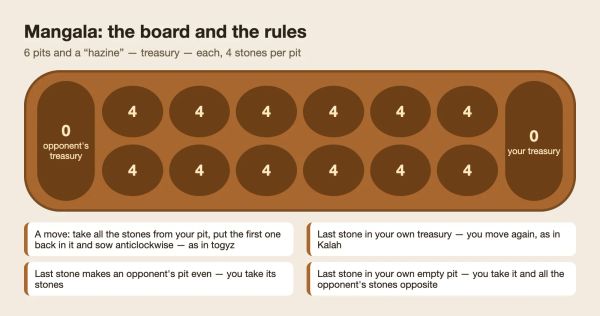
- Each player has 6 pits with 4 stones each and a treasury of their own.
- A move: take all the stones from one of your pits, put the first one back into the same pit and sow on anticlockwise — this comes from togyz.
- Last stone in your own treasury — you move again. That comes from Kalah.
- Last stone in your own empty pit — you take it and all the opponent's stones in the pit opposite. Also from Kalah.
- Last stone makes an opponent's pit even — you take its stones. From togyz again.
- Whoever has more stones in their treasury at the end wins.
The result is a fast, clear game with both calculation and traps. Since 2013 Turkish middle schools have had a "Mind Games" course (Zekâ Oyunları), and mangala is used as teaching material in primary and middle schools.
UNESCO
In 2020 Turkey, Kazakhstan and Kyrgyzstan jointly inscribed a "traditional intelligence and strategy game" on UNESCO's list of intangible heritage — togyz kumalak, toguz korgool and mangala. So the Turkic mancalas from Anatolia to the Tian Shan became one family on paper too.
And at VOG?
Status at VOG: under consideration. Its mancala relatives are already here or on the way: Kalah and oware, and togyz kumalak, which we have already written about in this series — it is in development.
If you play mangala, write to us: which rules do you use — the school ones or the old folk ones?