
Games of the World: games of skill — put your phone down
Gorodki, asyk knucklebones, “Chapaev”, carrom and crokinole: games played with your hands that cannot move online. Where they come from, how to play them for real — and why we recommend exactly that.
The eleventh article in our "Games of the World" series is an unusual one for an online club. It is about games that cannot move online, because they are played with your hands: throwing, flicking, knocking out. We will not make them — and we honestly recommend going out and playing them for real.
Gorodki
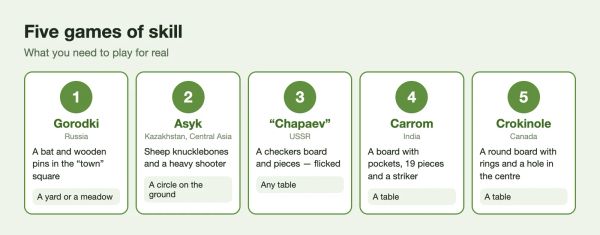
A Russian folk game rather like skittles. Players throw a heavy bat from a distance into a square "town" where a figure is built from wooden pins ("gorodki") and try to knock the whole figure out in as few throws as possible. There are fifteen figures, each with its own name: "cannon", "fork", "star", "arrow", "well", "artillery" — and the trickiest, the "letter", which has to be "opened" by knocking out the central pin.
By the 17th century the game was already close to its present form; Peter the Great, Suvorov, Leo Tolstoy and the physiologist Pavlov are said to have played it. There were no written rules until 1923, when they were codified and the first all-Union competition was held, and in 1928 gorodki was on the programme of the All-Union Spartakiad. Today it is played in Russia, Karelia, Finland, Sweden and the Baltic states; the Finns have their own relative, kyykkä.
How to play: you need a bat (a sturdy stick will do) and a couple of dozen identical wooden pins. Draw a square, step back ten paces — and build a "cannon".
Asyk
A Kazakh game played with sheep knucklebones — asyks. Each player has their own set of bones and a heavy, often dyed shooter called a saka. The bones are set in a row or a circle and knocked out with the shooter; what matters is not only hitting them but also how a bone lands — it has four sides, each with its own meaning. In 2017 UNESCO added Kazakh traditional asyk games to the list of the intangible cultural heritage of humanity. Kazakhstan has an asyk atu federation, and its tournaments are played mostly by children and teenagers aged 4 to 18.
How to play: you need a set of asyks and a circle drawn on the ground.
"Chapaev"
A game every Soviet schoolchild knew: the checkers are set out on the first row at both ends of the board, and players flick their own pieces to knock the opponent's off the board. A piece of yours that flies over the edge is lost too. It is named after the Civil War hero Vasily Chapaev.
How to play: a checkers board and pieces are in almost every home. If you play our checkers online while a real board gathers dust in a cupboard, here is a reason to take it out.
Carrom
India's "tabletop billiards". A square board with pockets in the corners, nine white and nine black pieces and a red "queen" in the centre. You flick a heavy striker to knock your pieces into the pockets. The queen only scores if you "cover" it by pocketing one of your own pieces right after it. The International Carrom Federation was founded in 1988 in Chennai, and in South Asia there is a carrom board in almost every club and café.
How to play: carrom boards are sold ready-made; at a pinch, a smooth table and checkers pieces will do.
Crokinole
A Canadian game on a round wooden board with rings worth 5, 10 and 15 points and a hole in the centre worth 20. Players flick their discs as close to the centre as they can and knock out their opponents'. The oldest known board was made in 1876 in Ontario, and since 1999 a world championship has been held every June in the small town of Tavistock, Ontario.
How to play: a crokinole board is a lovely thing for the home and for family evenings.
And at VOG?
We will not make online versions of these games. The club does not run games for money. We choose games by the player's decisions, community interest, a suitable competitive format and the resources to build them well. And what matters most in these games is the hand, the eye and the live excitement at the table or in the yard. Some of them do have digital versions, but those are different games: the score remains, the throw does not.
But we have an idea: to let you record the results of live games from your phone and keep tables in the club — for yard gorodki tournaments, school "Chapaev" or a family carrom championship. If that interests you, write to us about how you play and how you keep score.
Until then, put your phone down, call your friends and children, and play for real.