Thirteen kinds of checkers: what sets them apart
Russian and Give Away, International and Checkers — and now Spanish, Czech, Thai, Frisian and Turkish too. Five questions that tell all kinds of checkers apart, a table and examples on the board.
The club now has thirteen kinds of checkers. In November five new ones joined the eight familiar kinds: Spanish, Czech, Thai, Frisian and Turkish. Every kind has its own rooms, its own rating and rooms for playing against bots.
A chequered board, pieces moving diagonally, compulsory capture — almost every kind shares these. But sit down at a board with a player from another country and you will find that your rules differ. Here is what sets the kinds of checkers apart and how to choose what to play today.
Five questions about the rules
Almost any kind of checkers can be described by its answers to five questions.
1. What board and how many pieces. Usually 8×8 and 12 pieces each. International and Frisian draughts are played on a 10×10 board with 20 pieces each, Canadian on a huge 12×12 board with 30. Thai has only 8 pieces each, Turkish has 16.
2. Can a man capture backwards. In Russian, Give Away, Brazilian, Pool, International, Canadian and Frisian — yes. In Checkers, Italian, Spanish, Czech and Thai a man captures only forwards, and in Turkish — forwards and sideways.
3. What kind of king — flying or short. A flying king travels along a diagonal across the whole board and captures from a distance. A short king moves one square diagonally, but both forwards and backwards. Short kings are found in Checkers and Italian.
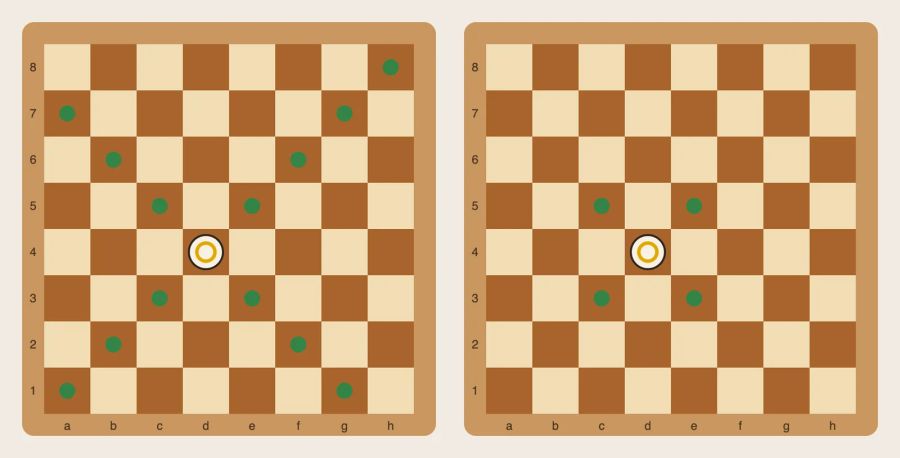
Left — Russian: the king on d4 may stop on any marked square. Right — Checkers: only on the four neighbouring ones.
4. Must you take the most pieces. In Russian, when there are several ways to capture, you choose the route yourself — as long as you finish the capture you started. You may pick a route that takes one piece even if another would take two. In Brazilian, International, Canadian, Spanish, Italian and Turkish the majority rule applies: you must capture where you remove the most pieces. Frisian has its own version — it counts not the number of pieces but their value.
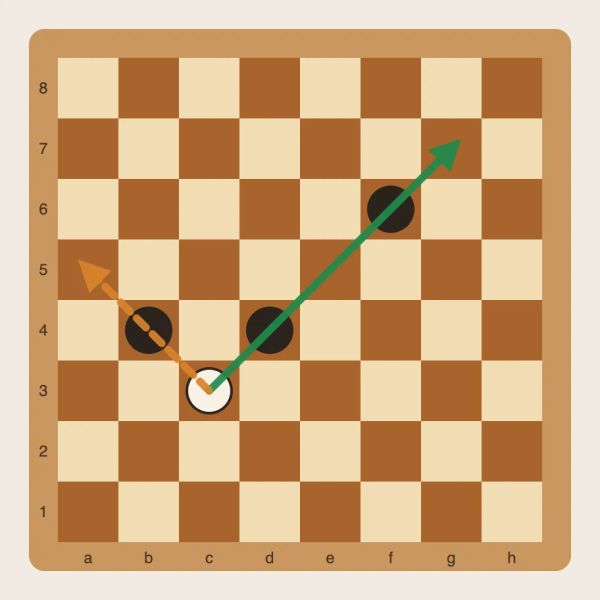
The white man on c3 can take one piece (orange arrow) or two (green). In Russian either route is fine, in Brazilian and International only the green one.
5. What happens when a man reaches the last row in the middle of a capture. This is where the kinds differ most:
- in Russian and Give Away the man becomes a king at once and keeps capturing as a king;
- in Checkers, Italian, Spanish, Czech and Thai it becomes a king and the move ends there;
- in Brazilian, Pool, International, Canadian, Frisian and Turkish it keeps capturing as a man and becomes a king only if it ends its move on the last row.
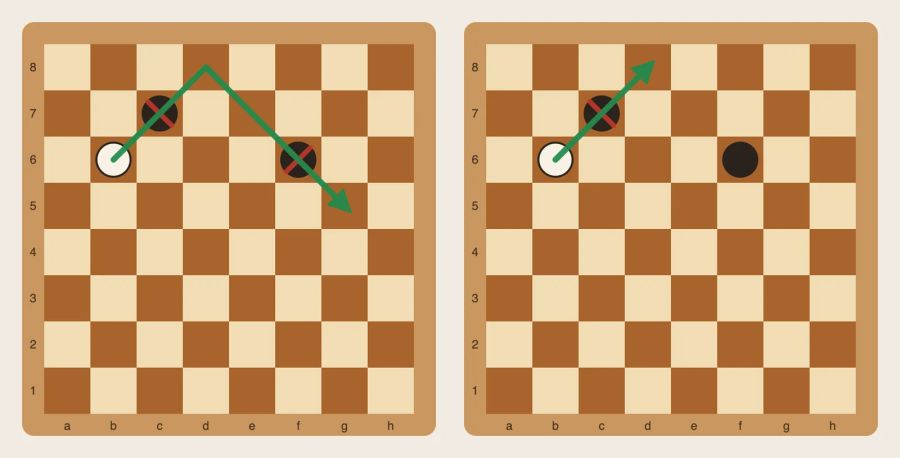
The same position. Left — Russian: the man captures from b6 to d8, becomes a king and immediately captures on to g5. Right — Brazilian: the capture ends on d8, as a man has nothing more to take from there.
All thirteen kinds in one table
| Kind | Board, pieces | Man captures backwards | King | Must take the most | Who moves first |
|---|---|---|---|---|---|
| Russian | 8×8, 12 | yes | flying | no | White |
| Give Away | 8×8, 12 | yes | flying | no | White |
| Brazilian | 8×8, 12 | yes | flying | yes | White |
| Pool | 8×8, 12 | yes | flying | no | Black |
| International | 10×10, 20 | yes | flying | yes | White |
| Canadian | 12×12, 30 | yes | flying | yes | White |
| Checkers | 8×8, 12 | no | short | no | Black |
| Italian | 8×8, 12 | no | short | yes, if equal — more kings | White |
| Spanish | 8×8, 12 | no | flying | yes, if equal — more kings | White |
| Czech | 8×8, 12 | no | flying | no, but the king captures first | White |
| Thai | 8×8, 8 | no | flying, lands right behind the captured piece | no | White |
| Frisian | 10×10, 20 | yes, and in straight lines | flying | yes, by value | White |
| Turkish | 8×8, all squares, 16 | no, but sideways | flying, in straight lines | yes | White |
The names of the kinds in the table link to their full rules.
The Russian family
Russian checkers is the most familiar kind for us: a flying king, a man that captures backwards too, a free choice of capture and the famous crowning in the middle of a capture. There is a subtlety called the "Turkish strike" (it has nothing to do with Turkish draughts): captured pieces are removed only after the move, so you cannot jump the same piece twice, and sometimes it gets in the way of continuing the capture.
Give Away is Russian checkers with the opposite goal: the winner is the first to give away all their pieces or run out of moves. Capturing is still compulsory, and the whole game is built on that — you have to force your opponent to eat.
The International family
International draughts is the main competitive game in the world: a 10×10 board, 20 pieces each and the majority rule. Brazilian has the same rules on an ordinary 8×8 board. Canadian is played on a 12×12 board with 30 pieces each; games are long and strategic. Pool resembles Brazilian but has no majority rule, and Black moves first.
Checkers and Italian
Checkers is English and American draughts. A man captures only forwards, the king is short, Black moves first. The game looks simple, but the short king makes it positional: endgames are played out long and precisely.
Italian draughts is strict about the choice of capture: you must take the most pieces, and if equal — the most kings. And a man cannot capture a king at all. The board is also turned: the dark corner square is on the player's right.
The new kinds
Spanish is like International moved to an 8×8 board, but a man captures only forwards, and a man reaching the last row stops there. You must take the most pieces, and if equal — the most kings. The board is mirrored: the long diagonal runs on the right.
Czech has the same moves as Spanish, but the choice of capture is free. With one exception: if both a king and a man can capture, the king must capture — even if the man would take more.
Thai checkers (Mak-hot) is played with only 8 pieces each on two rows. The king captures from a distance but lands only on the square right behind the captured piece and captures on from there. A captured piece is removed at once, so in a long capture you may cross its square again.
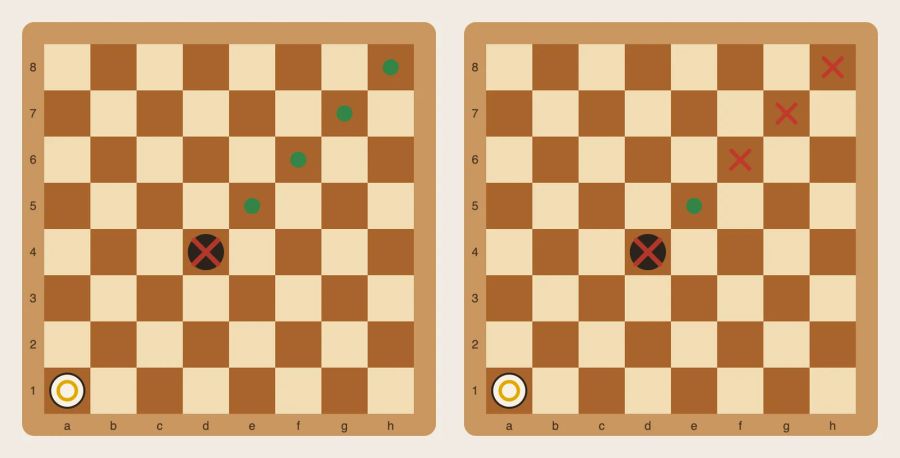
The white king on a1 captures the black man on d4. Left — Russian: it may land on any free square beyond it. Right — Thai: only on e5.
Frisian draughts is an old game from the Netherlands with its own official rulebook. Men and kings capture not only diagonally but also in straight lines — forwards, backwards and sideways. In a straight line the next dark square is two squares away, so a straight capture jumps over the piece and lands one square further on. You must choose the most valuable capture: a king is worth more than a man but less than two men. And while a player still has men, the same king may not make more than three quiet moves in a row.
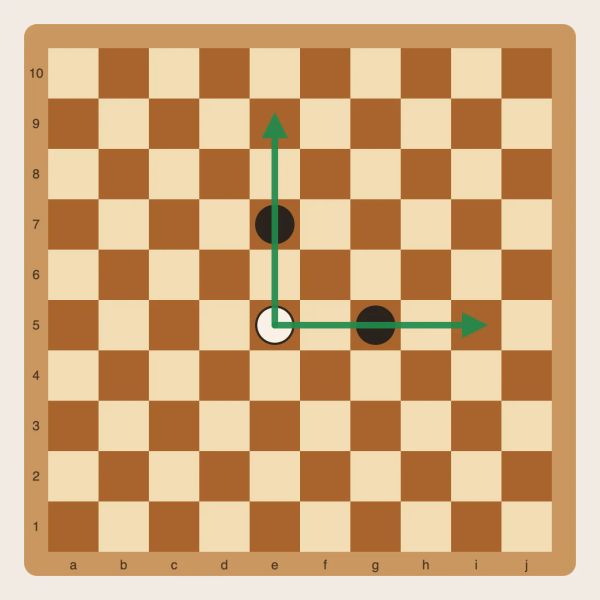
Frisian, 10×10 board: the white man on e5 can capture along the row — to i5 — or along the column — to e9.
Turkish draughts is the least like the others. It is played on all 64 squares, the board has a single colour, and each player has 16 pieces on the second and third rows. Pieces move and capture not diagonally but in straight lines: a man forwards and sideways, a king like a rook in chess, any distance in four directions. Captured pieces are removed at once, and you must take the most pieces. If you prefer a two-colour board, you can switch it on in the table's "Options".
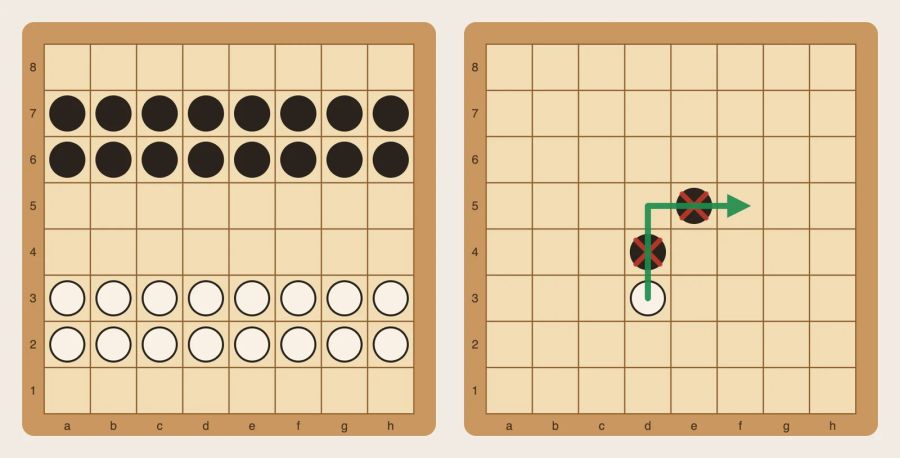
Left — the starting position. Right — the white man captures forwards from d3 to d5 and at once sideways to f5.
Where to start
- You play Russian — try Give Away: the same rules, but you have to think the other way round. Then Brazilian: the same board, but with the majority rule.
- You want a serious competitive game — International.
- You want something unusual — Turkish or Frisian: after them Russian checkers will feel completely different.
- Short of time — Thai: 8 pieces each, games are usually shorter and sharper.
Every kind has rooms for playing against bots: Artamonov_Bot plays at full strength, Artamonov_M and Artamonov_E are easier opponents. The rules of every kind are collected in the "Rules" section, and you can try Russian and English checkers without signing up — the "Play right now" card is on the home page and on the checkers page.
Which checkers have you played? Write to us — tell us which kind to add next.