Four kinds of chess: what sets them apart
Classic chess, Chess 960, King of the Hill and Three-check. The pieces move the same way everywhere — what changes is the starting position or the way to win. We explain with examples and suggest where to start.
The club now has four kinds of chess. In November three new ones joined classic chess: Chess 960, King of the Hill and Three-check. Each new kind has its own room, its own rating and a room for playing against bots.
You won't have to learn the moves again. In all four kinds the knight moves in an L shape, a pawn promotes to a queen, rook, bishop or knight, and checkmate and stalemate work as usual. The main differences are the starting position and extra ways to win.
All four kinds in one table
| Kind | Starting position | Other way to win besides checkmate | Draw when nobody can mate |
|---|---|---|---|
| Classic chess | standard | — | yes |
| Chess 960 | random, the same for both | — | yes |
| King of the Hill | standard | bring your king to the centre of the board | no |
| Three-check | standard | give your opponent a third check | only king against king |
The names of the kinds in the table link to their full rules.
Classic chess
The chess everyone knows: at the club you can play bullet, blitz, standard, tournaments and simultaneous matches. In the bots room there are six opponents running on the Stockfish engine — from the very easy Pawn_Bot to the very strong King_Bot.
Chess 960
This kind was invented by world champion Bobby Fischer, which is why it is also called Fischer Random chess. The pawns stand as usual, but the pieces on the first rank are placed at random, following two rules: the bishops stand on squares of different colours, and the king stands between the rooks. There are exactly 960 such positions, hence the name. One of them is the standard one; the club leaves it out, so you get one of the other 959. Black's pieces mirror White's, so the sides are equal, and the position is chosen anew before every game.
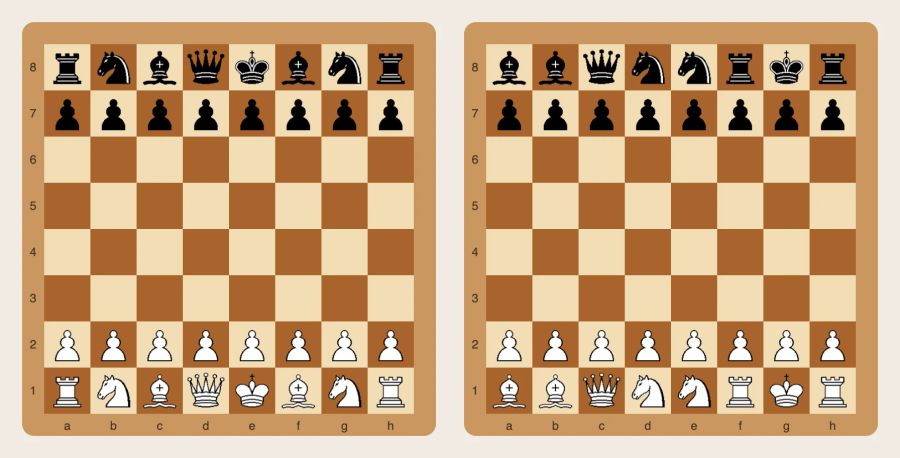
Left — the standard starting position. Right — one of the 960: the bishops stand side by side in the corner, the queen is on c1, the king on g1.
Why play it? In classic chess many players make their first moves from memory: openings have been studied twenty moves deep. In Chess 960 memorised lines won't help — you have to think from the very first move. Yet everything you know about the centre, developing your pieces and king safety still works here.
Castling exists too. Afterwards the king and rook end up where they would in ordinary chess: when castling short the king goes to g and the rook to f; when castling long the king goes to c and the rook to d. You can castle if the king and that rook have not moved yet and no other pieces stand in the way of the king and the rook to their destination squares. The king may not be in check, pass through an attacked square or land on one. To castle, click your king and then your rook.
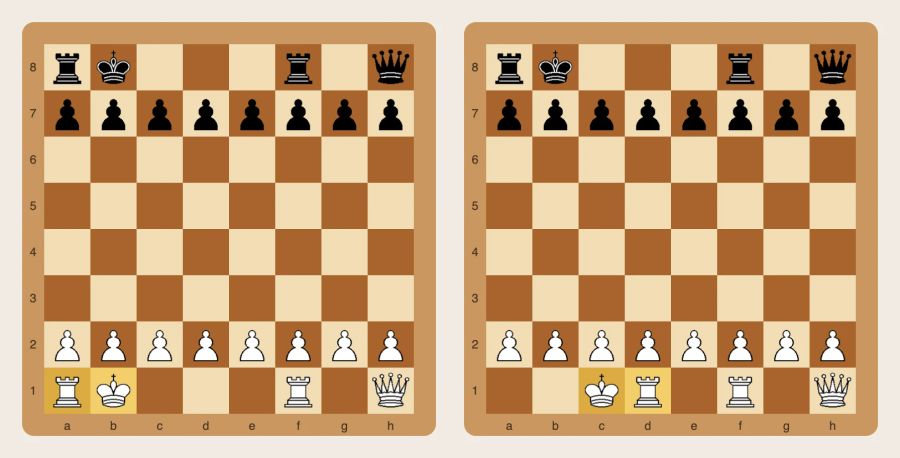
Long castling: the king goes from b1 to c1 and the rook from a1 to d1, so both of these squares must be empty. The result is the same as after long castling in ordinary chess.
King of the Hill
The starting position is standard, but besides checkmate there is one more way to win: bring your king to the centre of the board — to d4, e4, d5 or e5. The game ends at once. The king can get there by any legal move, including a capture, but it may not step onto a square the opponent attacks.
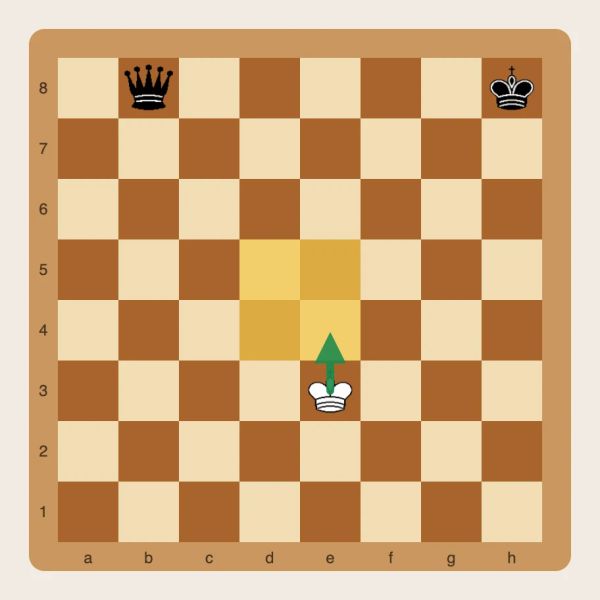
Black has a queen, White has only a king. In ordinary chess White would sooner or later be mated, but here the king's move to e4 wins the game at once.
In this kind the king is not only a piece to be hidden but also your main attacker. Especially in the endgame: once the queens are off, the king rushes to the centre, and the opponent has to keep the central squares covered. There is no draw for insufficient material here: even a lone king can reach the centre.
Three-check
The starting position is standard as well, but you can win by giving your opponent a third check during the game. Every check counts, including a discovered one, and the number of checks each side has given is shown under the board.
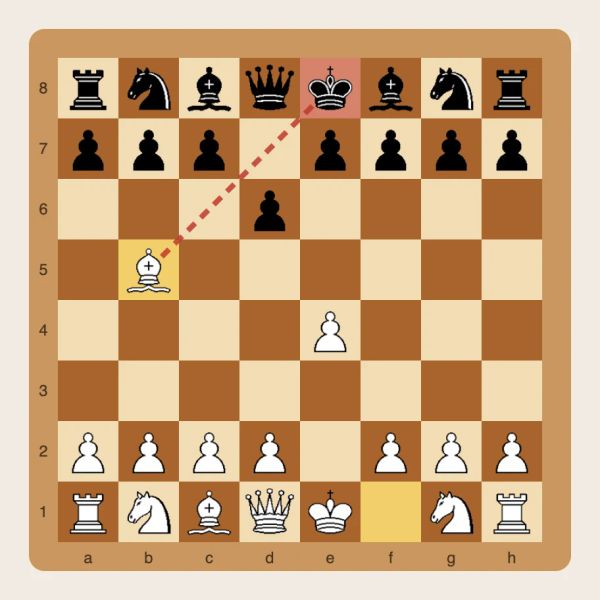
After 1.e4 d6 the white bishop goes to b5 and gives check. In ordinary chess Black would simply block it, but here White already has one check out of three.
The games are sharp: players often sacrifice a piece for a check, and the king has to be guarded from the first moves. A tip for beginners: don't rush to open lines in front of your king, and keep an eye on where your opponent could give check from. A draw for insufficient material happens only when two bare kings are left.
Where to start
- You know your openings by heart and want something fresh — Chess 960: the same chess, but every game starts from a clean slate.
- You like an active king and endgames — King of the Hill.
- You like attacks and sacrifices — Three-check: games are short and sharp.
In the rooms of the new kinds for playing against people, the time control is blitz: from 3 to 15 minutes per player. Against bots you choose the time yourself — from a minute to a day, or no limit at all. Each kind has its own room for playing against bots: in Chess 960 the same six opponents as in classic chess, in King of the Hill and Three-check four, from Pawn_Bot to King_Bot. The rules of every kind are collected in the "Rules" section, and you can play on the chess page.
Which kind of chess would you like to try? Write to us — tell us what to add next.