Games of the World: Dots, from the school exercise book to a rating
Squared paper and two pens: surrounding, houses and grounding. Not to be confused with Dots and Boxes. A sports club with a rulebook, millions of casual players — and our check of whether moving first gives an advantage.
The seventh article in our "Games of the World" series is about a game you don't have to buy: all you need is squared paper and pens in two colours. This is Dots (Tochki in Russian, Kropki in Polish), and it has had an unexpected fate — from the school exercise book to a sports rating.
A game from the back of the classroom
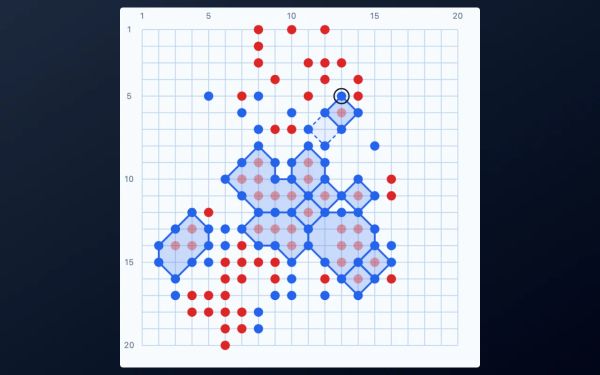
Two players take turns putting dots on the crossings of the grid and try to surround the opponent's dots with a closed chain of their own. Surrounded dots are points. Nobody knows who invented Dots or when: no one ever published it, and it was passed from hand to hand, like Battleship and noughts and crosses. It is known in Russia, Ukraine (krapky), Poland (kropki) and the Czech Republic (židi), but hardly at all further west.
Don't confuse Dots with the English game Dots and Boxes, where you connect dots with lines and claim the closed squares. That is a completely different game with a different strategy.
How to play
- A move is one dot on any free grid point. You may not pass.
- Your dots next to each other — horizontally, vertically or diagonally — form a chain. Close a chain around an opponent's dot and everything inside is yours; each surrounded dot scores a point.
- A chain with no enemy dots inside is a house. The opponent may put a dot in it, but unless that dot closes a ring of its own on the same move, it is counted as surrounded.
- A surrounded area can be surrounded again — and the dots inside are freed.
- Grounding is the key technique of the sport: the leading player declares the end, everything of theirs that is unprotected goes to the opponent, and the game is scored.
The rules are simple, but the fights for enclosure quickly start to resemble Go: nets, "eyes", tempo and a feel for the whole board matter here too.
From the exercise book to sport
Dots has a sporting life. The СКСТ sports dots club keeps rating lists, holds championships and maintains the most detailed written rulebook, with numbered articles like a chess code. The tournament board is 39×32 — exactly one page of a school exercise book. Poland has the kropki forum and the zagram tournament site, and players hold blitz championships online.
Yet the sporting circle is small: tens of people in the rating lists, while casual players number in the millions, and the most popular Dots app has more than two million installs. That mass audience still has no rating, no fair opponents and no game analysis.
Who moves first
The eternal question of any two-player game is whether the player who starts wins. For Dots it seems nobody had measured it. We checked ourselves: a strong neural network played hundreds of games against itself on each board. No first-move advantage was found — Blue and Red win about equally often, and most games of strong play end in a draw, with the board divided.
And at VOG?
Status at VOG: in testing. The game is ready and we are checking it before opening; you cannot play it yet. What it will have: 20×20, 30×30 and the tournament 39×32 boards, a start from a cross and a "four crosses" variant, rules following the СКСТ rulebook, a rating for every game, five bots from beginner to strong player — and an honest "bot" label on every one of them, with no bots posing as people.
Until then, take a squared exercise book and play the old way, at break time or at the kitchen table. If you play Dots seriously, write to us: we want to make the game the way you play it. And of our games, the closest to Dots in spirit is Go — there you surround too.