
Xiangqi
Xiangqi is Chinese chess: two players on a board of line intersections, each with sixteen pieces — a general, two advisors, two elephants, two horses, two chariots, two cannons and five soldiers. The goal is to checkmate the opponent's general. The club plays by the rules of the World Xiangqi Federation (WXF) with a simplified treatment of repetitions.
The board
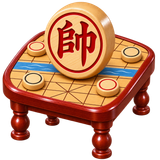
The board has 9 files and 10 ranks; the pieces stand on the intersections, not in squares. Across the middle runs the river, dividing the board into two halves. Each side has a palace — a 3×3 square of points with diagonals at its own edge of the board.
Red and Black play, and Red moves first; Red sits at the bottom. The pieces are round discs marked with Chinese characters or western icons — choose the set in the table's “Options”.
How the pieces move
- General (帥/將) — one point along a file or rank, only inside the palace.
- Advisor (仕/士) — one point diagonally, only inside the palace.
- Elephant (相/象) — exactly two points diagonally and never across the river. If the point in between is occupied (the “elephant's eye”), the move is not allowed.
- Horse (傌/馬) — one point straight and then one point diagonally, away from where it started. If the first point is occupied (the “horse's leg”), the move is not allowed.
- Chariot (俥/車) — any number of points along a line, like a rook.
- Cannon (炮/砲) — moves like a chariot but captures by jumping over exactly one piece (of either colour) on the line to its target.
- Soldier (兵/卒) — one point forward; once across the river it may also move sideways. It never moves backwards and never promotes.
A capture is a move onto a point held by an enemy piece, which is removed.
Generals facing each other
The generals may not stand on the same file with nothing between them. A move that would allow this is forbidden, just like a move that leaves your own general under attack. So a piece standing between the generals can be pinned.
End of the game
- Checkmate — the general is attacked and cannot be saved: the side that gave mate wins.
- Stalemate — a side has no legal move but is not in check. In xiangqi this is a loss for the stalemated side, not a draw.
- Resignation and time: whoever resigns loses; whoever runs out of time loses — unless the opponent has no chariots, horses, cannons or soldiers left, in which case it is a draw.
Repetitions
When a position with the same side to move occurs for the third time, the game ends and the server looks at what each side did over those moves:
- one side checked on every move and the other did not — the checking side loses (perpetual check);
- one side, without checks, kept attacking the same unprotected piece of the opponent (other than the general and soldiers) — the chasing side loses (perpetual chase); attacks by the general or a soldier do not count as a chase;
- both sides break the rules, neither does, or checks and attacks alternate — draw.
Source and interpretation: WXF rules. Our handling of repetitions is simplified: the server treats only perpetual check and perpetual chase of a single unprotected piece as violations, and settles the finer cases of the WXF code as a draw. Under the rules of the Chinese Xiangqi Association (2020), a perpetual mate threat and alternating a check with a mate threat or an attack are also forbidden; here, as under WXF rules, they are a draw. Under the Asian Xiangqi Federation (AXF) rules a no-capture draw comes after 50 moves by each side, with checks counted no more than 10 times; here it is 60 moves (30 per side), with checks not limited.
Draws
- 60 moves without a capture (30 per side) — draw.
- Insufficient material: neither side has a chariot, horse, cannon or soldier left — draw.
- By agreement — with the “Draw” button at the table.
Rooms and rating
- Blitz — 5 minutes plus 3 seconds per move, rapid — 15 minutes plus 10 seconds, classic — 60 minutes plus 30 seconds; games in all three are rated.
- The room with bots has four bots of different strength and its own rating for games against bots.
- The practice room is unrated, with the weaker bots.
The rating is Elo per game, starting at 1600. Moves at the table and in the archive are written in WXF notation; how to read it is explained under “Strategy”, topic “Notation”.
Rule sources
The rulebooks our rules are based on. Where we depart from them is explained in the text above.
- World Xiangqi Rules (opens in a new tab) — World Xiangqi Federation (WXF), 2018 · international · en
- 象棋比赛规例 (opens in a new tab) — 亚洲象棋联合会 (Asian Xiangqi Federation), 2017 · Asia · zh