Mus: the Basque partnership card game comes to the club
Four lances, envido and an órdago on the whole game, signs only your partner sees. Three tables — with signs, without and “4 kings” — three bots, a personal rating by the pair's result, archive and deal check.
You can now play mus at the club — the great card game of the Basque Country and all of Spain. Four players, two partnerships facing each other, a forty-card Spanish deck — and a round of bidding decided by bets, bluff and signs to your partner. Cards are hardly played in mus: the game goes to whoever judges the hands better, their own and everyone else's.
Play with bots → — you can finish the rules after the first deal.
How it is played
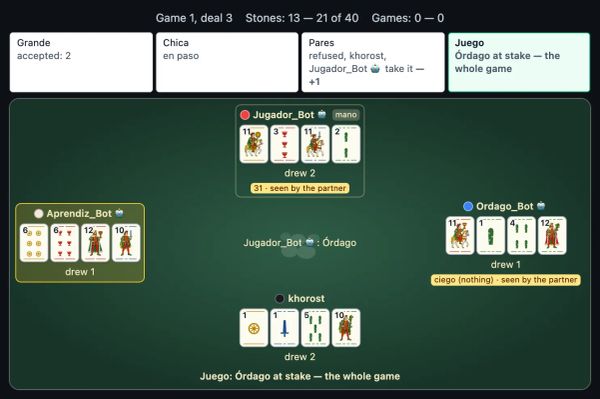
Each player gets four cards. First comes the discard: if all four say “mus”, everyone throws away one to four cards and draws new ones. The first “no hay mus” ends the discard, and the bidding begins on four lances:
- Grande — highest cards;
- Chica — lowest cards;
- Pares — best combination: a pair, medias (three of a kind) or duples;
- Juego — a total of 31 or more, and if nobody has it, punto — closest to 30.
In each lance you can pass, bid envido or answer a bid — quiero or no quiero. And órdago is a bid on the whole game: if it is accepted, the hands are shown, and whoever wins the lance wins the game. A game goes to 40 stones, a match to two games won.
You don't need to count anything: the table deals, compares the hands, announces who has pares and juego and keeps the score in stones. All the details are in the rules.
Signs to your partner
In mus you may show your partner what you hold: two kings, three aces, medias, duples, 31 or ciego — neither pares nor juego. Over a real table that is a wink or a bitten lip; here it is a button. Only your partner sees the sign, the opponents don't. The table won't let you show what you don't have, so a sign can be trusted.
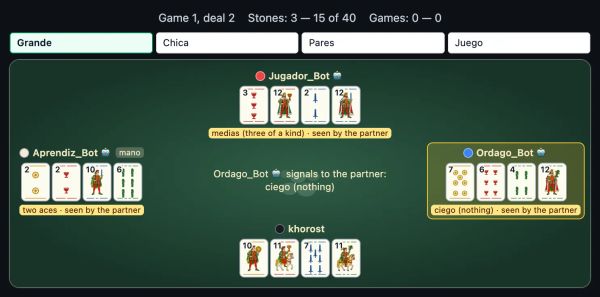
After the game the archive shows all signs to everyone, marked “seen by the partner” — handy for seeing how a pair talked.
Three tables and a room with bots
- Mus — the main table: “8 kings” (threes count as kings, twos as aces) and signs.
- Mus sin señas — the same mus without signs: partners talk only through bidding.
- Mus 4 reyes — the old count, where threes and twos are ordinary cards.
- Mus, bots — a game with bots: they take three seats, including your partner's.
On the clock — 10 or 15 minutes per player and 5 seconds per move.
There are three bots: Aprendiz_Bot, Jugador_Bot and Ordago_Bot — from beginner to the strongest. They bid, bluff and show their partner truthful signs.
Rating
The rating is personal and depends on the result of the pair: when a pair wins, both partners gain. In rated matches seats at the table are assigned at random. The Mus, sin señas and 4 reyes tables share one scale, “Mus”. Games with bots have their own scale, “Mus, with bots”.
Archive, Telescope and a fair deal
In the archive you can replay the matches you have played, with a frame for every action: discard, bets, signs, showdown and count. Fresh games appear in the Telescope on the home page. And the deal check page lets you recompute the deck of every deal and see for yourself that the cards fell fairly.
The strategy section has five parts: when to say “mus”, hand strength by lance, órdago and the score, your partner's signs and tips for playing against bots. Rules and strategy are available in all fifteen languages of the site.
The easiest way to start is the game page: sit down in the room with bots, and Ordago_Bot will show you why mus takes courage.
Come and play — your partner is waiting for your sign!